
Last reviewed: August 31, 2026
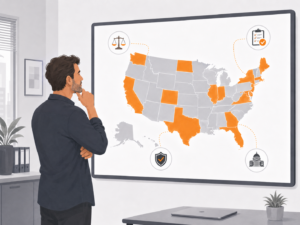 Nine states currently have statewide laws requiring at least some retail businesses or places of public accommodation to accept cash: Massachusetts, Colorado, Connecticut, Delaware, Montana, New Jersey, New York, Oregon, and Rhode Island.
But for businesses that operate cashless, the number of states with cash acceptance laws is only the beginning of the question.
In some jurisdictions, cash must be accepted directly at the point of sale. In others, a business may remain operationally cashless by providing a compliant device that converts cash to a prepaid card or another cashless payment instrument. The technical requirements for those devices also vary significantly from one jurisdiction to another.
For venues, stadiums, entertainment facilities, retailers, restaurants, and other operators considering a cashless payment model, the important question is not simply whether a state requires cash. It’s what the law requires at each specific location, and whether it allows cash-to-card conversion as an alternative.
This guide covers the statewide cash acceptance laws currently in effect, selected major city and county requirements, where cash-to-card conversion is expressly addressed, and some of the venue-specific exceptions operators should know about.
This guide is provided for general informational purposes and is not legal advice. Cash acceptance laws, regulations, agency guidance, and local ordinances can change. Businesses should confirm current requirements for each location with qualified counsel or the appropriate government agency.
What is a cashless ban?
A cashless ban is a law that limits a business’s ability to refuse cash for an in-person transaction.
These laws are generally intended to preserve access for consumers who do not have credit cards, bank accounts, smartphones, or other forms of electronic payment, as well as consumers who choose to use cash for budgeting, privacy, or convenience.
Despite the “legal tender” language printed on U.S. currency, there is no federal law requiring every private business to accept cash for a retail purchase. The Federal Reserve specifically notes that private businesses may establish their own payment policies unless state or local law says otherwise.
That is why cash acceptance in the United States is a patchwork of state, county, and city rules.
And increasingly, those rules do more than say whether cash must be accepted. Some now specify whether a customer can instead convert cash to a prepaid card, what the conversion device must do, what fees are prohibited, and even what happens when the device is temporarily out of service.
State cash acceptance laws in 2026
The table below summarizes the nine states with statewide cash acceptance requirements and, critically, how each law treats cash-to-card or similar cash conversion systems.
| State | Cash acceptance requirement | Cash-to-card / conversion path | Important operator notes |
|---|---|---|---|
| Massachusetts | Yes | No express conversion-device safe harbor in the current statute | Massachusetts law broadly requires retail establishments to accept legal tender. |
| Colorado | Yes | Yes | A retail establishment may use a device that converts cash to a prepaid card without a fee and with a required minimum deposit of no more than $1. |
| Connecticut | Yes | Yes | Connecticut expressly allows qualifying cash-to-prepaid-card devices. Requirements include no card or usage fees, a minimum deposit no greater than $1, no expiration of funds, unlimited transactions, no required personally identifiable information, receipts on request, and a cash fallback if the device malfunctions. |
| Delaware | Yes | Yes | An on-premises prepaid-card device may qualify if it charges no fee, requires no deposit greater than $5, provides receipts on request, and provides non-expiring funds with no transaction limit. Sporting and entertainment events, including music festivals, are excluded from the statute’s definition of a covered retail store transaction. |
| Montana | Yes | Yes | Montana permits a device that converts cash to a prepaid card with no fee, a minimum deposit no greater than $1, receipts on request, non-expiring funds, and no transaction limit. Businesses with multiple points of sale at one address can comply by accepting cash at at least one point of sale. |
| New Jersey | Yes | No express conversion-device safe harbor in the statute | Certain businesses are exempt, including sports or entertainment venues with at least 10,000 seats. |
| New York | Yes | Yes | A qualifying on-site device may convert cash to a prepaid card with no fee and a minimum deposit no greater than $1. Additional requirements address receipts, expiration, transaction limits, and device downtime. |
| Oregon | Yes | Yes, under a broader cashless-payment-instrument model | Places of public accommodation, including live entertainment and sporting venues, may convert cash to cards, tokens, wristbands, or other prepaid instruments, provided conversion and remaining-balance refunds are fee-free. |
| Rhode Island | Yes | No express conversion-device safe harbor in the statute | Retail establishments must accept legal tender; online purchases and internet sales are excluded. |
The distinction between “no express conversion-device safe harbor” and “cash-to-card is prohibited” is important.
If a statute requires cash acceptance but does not specifically authorize conversion devices, a business should not assume that installing a kiosk automatically satisfies the law. It means the statutory text reviewed here does not create the type of explicit alternative compliance path found in states such as Colorado, Connecticut, Montana, and New York.
Cash-to-card exceptions are more common than they used to be
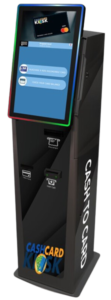 One of the most significant developments in cash acceptance law is that legislators are increasingly addressing cash conversion directly.
Colorado and Montana both provide statutory exceptions for qualifying prepaid-card conversion devices. Connecticut added a detailed device exception effective in 2025. Delaware also expressly addresses on-premises cash-to-card conversion. New York’s statewide law, effective in 2026, contains one of the clearest modern sets of requirements.
Oregon takes a somewhat different approach. Its law allows a place of public accommodation, expressly including venues used for live entertainment or sporting events, to require customers to convert cash into a cashless payment instrument such as a card, token, or wristband. The operator cannot charge a fee to convert the cash or to refund the customer’s remaining balance.
There is no single nationwide specification for a “compliant cash-to-card kiosk.”
A configuration that satisfies one state’s law may not satisfy another state’s requirements.
New York’s 2026 cash acceptance law
New York’s statewide law is especially important because it took effect on March 21, 2026, expanding cash acceptance requirements beyond New York City to covered businesses statewide.
The law, General Business Law § 396-ii, applies to food stores and retail establishments. Covered businesses generally cannot refuse cash for an in-person transaction or charge a cash-paying customer a higher price for the same consumer commodity. Businesses may refuse cash bills larger than $20, and certain telephone, mail, and internet-based transactions are excluded unless payment takes place on the premises.
New York’s cash-to-card exception
New York allows a covered business to use an on-premises device that converts cash to a prepaid card rather than accepting cash directly at each transaction.
To qualify under the statute, the device must:
-
- Convert cash without charging a fee
-
- Require no minimum deposit greater than $1
-
- Provide a receipt on request showing the amount deposited
-
- Provide funds that are not subject to an expiration date
-
- Place no limit on the number of transactions that can be completed with the prepaid card
The law also explicitly addresses equipment downtime.
If the conversion device malfunctions, the business must accept cash during the period when the device is unavailable and place conspicuous signage on or immediately adjacent to the device explaining the cash requirement. The statute also directs consumers to the New York Department of State Division of Consumer Protection to report violations.
Violations can carry civil penalties of up to $1,000 for a first violation and $1,500 for each subsequent violation.
For operators, that makes uptime more than a customer-experience issue. Where a statute includes malfunction provisions, serviceability and fallback procedures become part of the compliance plan.
App-based ordering is not automatically a cashless workaround
Cash acceptance laws frequently exclude transactions completed remotely by phone, mail, or internet. That has sometimes led businesses to assume that requiring customers to complete an in-person purchase through a mobile app converts the transaction into an exempt internet transaction.
At least in New York City, current guidance says otherwise.
In May 2026, the New York City Department of Consumer and Worker Protection clarified that when a business offers goods or services at a physical location and requires or facilitates app payment as part of the customer’s in-person transaction, the transaction is not automatically exempt from the city’s Cashless Ban.
The agency specifically gives examples of a coffee shop requiring customers physically on the premises to order through an app and a parking garage requiring app payment from customers at the garage. According to the guidance, those models do not avoid the cash acceptance requirement merely because an app is involved.
That guidance applies to New York City’s ordinance, and businesses elsewhere should evaluate the language and agency interpretation of the law governing their own location rather than assuming an app-based model creates an exemption.
Local cash acceptance laws: cities and counties matter too
State law is only one layer of the compliance picture.
Cities and counties have enacted their own cash acceptance requirements, sometimes in states that have no statewide cashless ban at all. For multi-location operators, compliance may therefore change when a business crosses a city or county boundary.
Here are several major local examples as of August 2026:
| Jurisdiction | Current status | Cash-to-card / conversion treatment |
|---|---|---|
| New York City, NY | In effect | Yes. NYC expressly allows an on-site machine that converts cash to a prepaid card when statutory requirements are met. |
| Philadelphia, PA | In effect | Yes. City regulations provide a compliance path when a seller gives customers ready access to an operational kiosk that converts cash to an all-purpose prepaid card without additional cost. |
| San Francisco, CA | In effect as of this review; repeal legislation has been proposed | No express cash-to-card safe harbor in current Article 55. The current code requires covered brick-and-mortar businesses to accept cash, subject to exceptions. A 2026 proposal would repeal Article 55, but the cash requirement remains in the current municipal code as of this review. |
| Berkeley, CA | In effect | Covered retail businesses are required to accept cash; the ordinance does not contain the kind of express conversion-device safe harbor found in New York or Colorado. |
| West Hollywood, CA | In effect | Businesses with a physical location open to customers generally must accept cash. The municipal code does not provide an express prepaid-card conversion safe harbor. |
| Detroit, MI | In effect | Yes. Detroit’s ordinance provides a conversion-device path with requirements addressing fees, minimum deposits, card expiration, transaction limits, redemption of unused balances, and personally identifiable information. |
| Miami-Dade County, FL | In effect, subject to significant scope and preemption considerations | Specific venue path. Event venues, including stadiums and arenas, can comply by maintaining at least one location on the premises where customers can purchase payment cards with cash. |
| Snohomish County, WA | In effect in unincorporated Snohomish County | Yes. If a retail establishment chooses not to accept cash, the county ordinance requires a cash exchange terminal to be available to customers, subject to exemptions. |
| King County, WA | Not yet effective | King County has adopted a cash acceptance ordinance for unincorporated King County, including a cash-conversion-device path, but its effective date has been postponed more than once and the requirement had not yet taken effect as of this review. |
The King County date is a good example of why operators should verify the current law rather than relying on an older compliance map. The ordinance was originally scheduled to take effect earlier, but the county has postponed implementation more than once.
Venue-specific rules deserve special attention
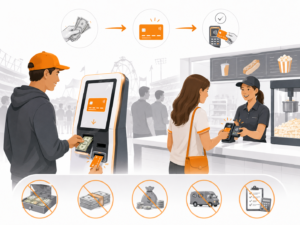 For stadiums, arenas, fairs, festivals, concert venues, amusement properties, and other high-volume environments, the law can look very different from ordinary retail.
Delaware, for example, excludes transactions at sporting and entertainment events, including music festivals, from the definition of covered retail-store transactions under its statewide law.
New Jersey exempts sports and entertainment venues with a seating capacity of at least 10,000.
Oregon goes in another direction: it expressly allows places of public accommodation, including live entertainment and sporting venues, to convert cash into a cashless payment instrument such as a card, token, or wristband, provided the customer is not charged for the conversion or for refunding an unused balance.
And Miami-Dade County treats event venues as compliant with its local cashless-retail prohibition when customers have at least one place on the premises where they can use cash to purchase payment cards.
For venue operators, this makes business type every bit as important as geography. Two businesses in the same state may face different requirements because one is a conventional retailer and the other is a stadium, festival, or entertainment facility.
What makes a cash-to-card device compliant?
There is no universal federal standard defining a cash-to-card kiosk that satisfies every state or local cash acceptance law.
But the statutes that expressly authorize conversion devices increasingly share several recurring requirements:
No conversion fee. Laws commonly prohibit charging the customer simply to convert cash to the prepaid card or payment instrument.
Low minimum load requirements. New York, Colorado, Connecticut, and Montana use a maximum minimum deposit of $1. Delaware allows a minimum deposit of up to $5.
No expiration of deposited funds. Several statutes expressly prohibit expiration of the underlying money loaded to the card.
No transaction-count limits. A qualifying prepaid card may be required to support an unlimited number of transactions.
Receipts. Several laws require the conversion device to provide a receipt on request showing the amount deposited.
Privacy requirements. Connecticut, for example, specifically prohibits requiring personally identifiable information to receive or use the prepaid card.
Downtime procedures. Connecticut and New York both require covered retailers to accept cash when their qualifying conversion device is malfunctioning.
For operators evaluating cash-to-card equipment, these details matter. The fact that a machine can technically accept a $20 bill and issue a card does not, by itself, mean that the system satisfies a particular jurisdiction’s law.
Cash acceptance laws are not all written for the same businesses
Another reason state-by-state compliance lists can be misleading is that the statutes themselves define covered businesses differently.
Some apply broadly to retail establishments. Oregon regulates places of public accommodation. Delaware excludes certain transaction types altogether. Connecticut excludes several categories of transactions and services. New Jersey expressly exempts certain large sports and entertainment venues.
That means a business should answer several questions before deciding what cash-handling model it needs:
- What state, county, and city is the location in?
- What type of business or venue is it?
- Is the transaction actually covered by the law?
- Does the jurisdiction expressly authorize a cash-conversion alternative?
- If it does, what technical requirements apply to the device and prepaid card?
- What is required if the device becomes unavailable?
Those questions are more useful than simply asking whether a state appears on a list of “cashless ban states.”
The federal picture
There is still no blanket federal law requiring private businesses to accept cash for ordinary retail purchases.
U.S. currency is legal tender for debts, public charges, taxes, and dues, but the Federal Reserve explains that legal-tender status does not itself force private businesses to accept currency or coins for every purchase. State and local laws can impose their own requirements.
Federal legislation seeking to create nationwide cash acceptance requirements has been introduced in Congress in multiple sessions, but no nationwide retail cash-acceptance mandate is currently in force.
For operators today, compliance therefore remains primarily a state and local issue.
What this means for cashless operators
Cashless operation remains legal across much of the United States, but the compliance landscape is becoming more detailed.
For businesses operating in jurisdictions that require cash, there are generally three possibilities:
The business may be required to accept cash directly.
The law may provide an express cash-to-card or cash-conversion alternative, provided the system satisfies specific requirements.
Or the business or transaction itself may fall within a statutory exemption, such as certain sporting venues, remote transactions, parking facilities, or other specifically defined categories.
The safest approach is to map requirements by individual location rather than applying a single national payment policy to every site.
And where a cash-to-card path is available, operators should evaluate more than the kiosk hardware itself. Card fees, minimum loads, card expiration, transaction limits, receipt capability, privacy, equipment uptime, service procedures, signage, and cash fallback policies can all matter under different laws.
Frequently Asked Questions
Which states require businesses to accept cash in 2026?
Nine states currently have statewide cash acceptance laws applying to at least some retail businesses or places of public accommodation: Massachusetts, Colorado, Connecticut, Delaware, Montana, New Jersey, New York, Oregon, and Rhode Island. The scope and exceptions vary substantially by state.
Can a business use a cash-to-card kiosk instead of accepting cash?
In some jurisdictions, yes. Colorado, Connecticut, Delaware, Montana, and New York expressly address qualifying cash-to-prepaid-card devices in their statewide laws. Oregon permits a broader cash-to-cashless payment system for places of public accommodation, including entertainment and sporting venues. Several local laws also provide conversion options. The specific technical and operational requirements vary by jurisdiction.
Is it illegal for a business to be cashless in New York?
Covered food stores and retail establishments in New York generally cannot refuse cash for in-person transactions. However, the statewide law allows a qualifying on-premises cash-to-prepaid-card device as an alternative. The device must satisfy requirements involving fees, minimum deposits, receipts, expiration, transaction limits, and downtime.
What happens if a cash-to-card kiosk stops working?
It depends on the jurisdiction. New York and Connecticut expressly require covered businesses relying on their statutory conversion-device exceptions to accept cash while the device is malfunctioning. Both also impose signage requirements associated with device downtime.
Does federal law require businesses to accept cash?
No. There is no federal statute requiring every private business to accept cash for goods or services. State and local governments can impose their own cash acceptance requirements.
Do cash acceptance laws apply to stadiums and entertainment venues?
Sometimes, but venue rules vary significantly. New Jersey exempts sports and entertainment venues with at least 10,000 seats. Delaware excludes transactions at sporting and entertainment events, including music festivals. Oregon expressly permits cash-conversion systems at places of public accommodation, including live entertainment and sporting venues. Miami-Dade County provides a specific compliance path for event venues that make payment cards available for purchase with cash.
Planning a cashless or cash-to-card program?
For operators considering a cashless environment, compliance starts with understanding the rules that apply to each location.
CashCardKiosk provides self-service cash-to-card solutions designed for venues and businesses that want to reduce on-site cash handling while maintaining a payment option for customers who arrive with cash.
Depending on the jurisdiction, the details of the program, including fees, minimum load amounts, receipt capability, card terms, equipment availability, and fallback procedures, may affect whether a particular cash-to-card configuration fits the applicable requirements.
Talk with CashCardKiosk about your locations, operational requirements, and cash-to-card deployment options.
CashCardKiosk does not provide legal advice. Businesses should consult qualified counsel to determine the requirements applicable to their specific locations and operations.