
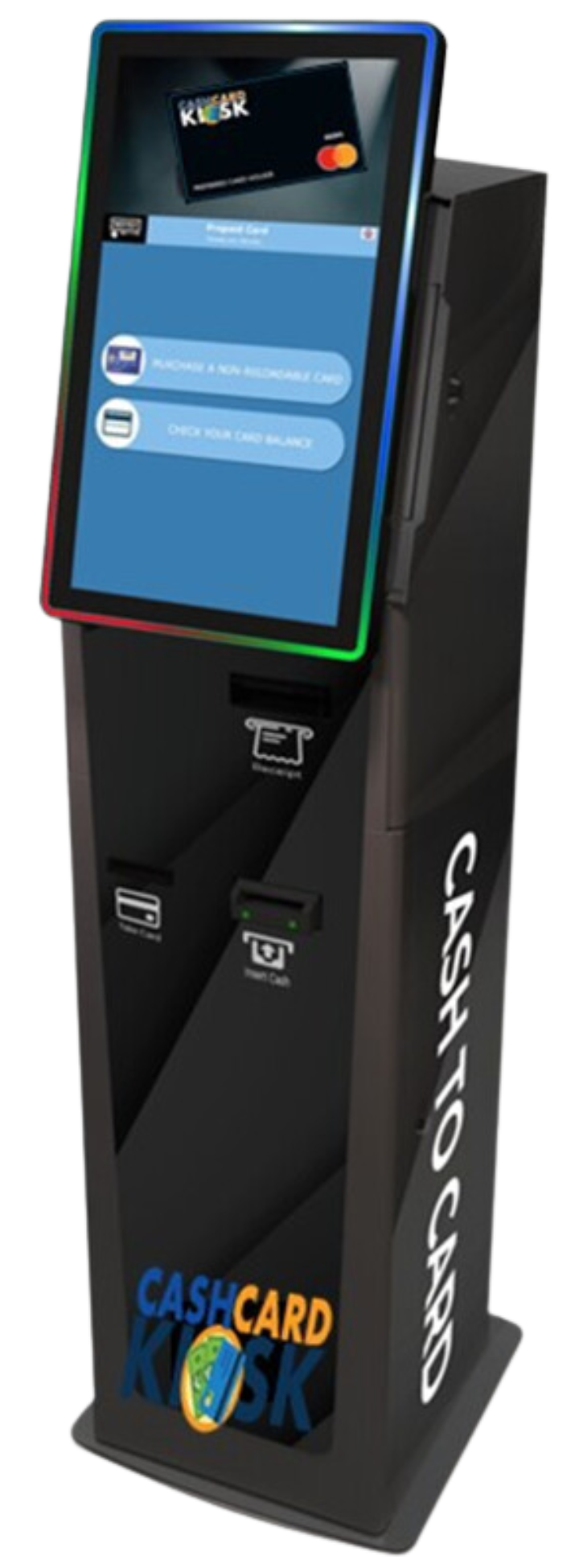
 Cash-to-card kiosks convert paper money into prepaid debit cards on the spot. A customer inserts cash, and the machine instantly issues a prepaid card loaded with that amount, ready to use anywhere the card network is accepted. They’re sometimes called reverse ATMs, because they do the opposite of what an ATM does: instead of turning your card balance into cash, they turn your cash into a card.
If you’ve been to a stadium, fair, casino, or amusement park recently and seen a “cashless venue” sign next to a kiosk, you’ve probably seen one in action. This guide explains what cash-to-card kiosks are, how they work, where they’re used, what they cost, how they compare to other payment options, and what both consumers and venue operators should know before using or deploying one.
What Is a Cash-to-Card Kiosk?
A cash-to-card kiosk is a self-service machine that accepts cash and dispenses a prepaid debit card in exchange. The card is loaded with the exact amount inserted, and in most programs it works anywhere that card network is accepted, not just inside the venue where it was issued.
The same machine goes by several names, and they all refer to the same technology:
-
- Reverse ATM, the most common alternative name
-
- Cash-to-card machine or cash conversion kiosk
-
- Cash exchange kiosk or cash-to-card converter
Most systems issue the card instantly, with no bank account, credit check, or personal information required. That last part matters, because it means the millions of people who prefer cash, or who don’t have a bank account or credit card, can still participate fully in places that no longer accept paper money.
How Does Cash to Card Work?
The process takes less than a minute at most kiosks:
-
- Insert cash. The kiosk accepts bills and validates them automatically.
-
- Confirm the amount. The screen displays the total inserted.
-
- Receive your card. The kiosk instantly prints or dispenses a prepaid debit card loaded with that amount.
-
- Spend it like any card. Tap, swipe, or insert at any register that accepts the card network, inside the venue and usually beyond it.
Behind the scenes, the kiosk combines a bill validator, a card dispenser, and a secure connection to a payment platform that activates each card at the moment it’s issued. There’s no account to set up and nothing to sign.
Cash-to-Card Kiosk vs. ATM: What’s the Difference?
An ATM starts with a card and ends with cash. A cash-to-card kiosk starts with cash and ends with a card. That’s why “reverse ATM” has become the everyday name for these machines.
The practical differences run deeper than direction:
-
- An ATM requires a bank account. A cash-to-card kiosk requires nothing but cash.
-
- An ATM dispenses money you already have on deposit. A cash-to-card kiosk creates a spendable card balance from the bills in your pocket.
-
- ATMs typically charge withdrawal fees to the cardholder. Cash-to-card programs vary, and many venues issue cards at full face value with no fee at all.
For venues, the distinction matters operationally too. An ATM adds more cash to the floor. A cash-to-card kiosk removes cash from circulation inside the venue, which is usually the entire point.
Cash to Card vs. Prepaid Debit Cards vs. Gift Cards
These three get confused constantly, and the differences decide where and how the money can be spent.
A gift card typically works only at the merchant that sold it. A closed loop. If the balance goes unused, it usually stays with that merchant.
A retail prepaid debit card, the kind sold on drugstore racks, runs on a major card network and works broadly, but usually involves purchase fees, activation steps, and sometimes registration requirements before full use.
A card from a cash-to-card kiosk combines the best of both: issued instantly with no registration, loaded with the exact amount inserted, and usable anywhere the card network is accepted. It behaves like a network prepaid card without the drugstore activation ritual, created at the moment of need, right where the need exists.
Where You’ll Find Cash-to-Card Kiosks
Cash-to-card kiosks appear wherever venues have moved to cashless operations but still serve guests carrying cash:
-
- Stadiums and arenas, where concession lines move faster when every register takes cards only
-
- Fairs and festivals, where handling large volumes of cash used to be a major security and logistics burden
-
- Casinos and entertainment venues
-
- Amusement parks and family entertainment centers
-
- Universities and campus dining
-
- Hotels, malls, museums, and expos
-
- Quick-service restaurants and retail locations operating card-only registers
The pattern is the same everywhere: the venue operates cashless for speed, security, and simpler operations, and the kiosk makes sure guests with cash aren’t turned away.
Why Venues Go Cashless, and Why Cash Still Matters
For a venue, cash is expensive. It has to be counted, reconciled, stored, transported, and protected against theft, fraud, and counterfeit bills. Registers that accept only cards move lines faster, reduce shrinkage, and close out cleaner at the end of the night. Staff spend their time serving guests instead of counting drawers.
But a meaningful share of guests still carry and prefer cash, and some rely on it entirely. Roughly one in twenty American households has no bank account at all, and many more are underbanked, using cash for most daily spending. Turning those guests away means lost sales and frustrated customers, and in a growing number of places it isn’t legal to refuse cash at all.
Cash-to-card kiosks resolve that tension. The venue gets the operational benefits of cashless registers, and cash-carrying guests get a fast way to convert their money and keep spending. Nobody gets turned away at the register.
The Financial Inclusion Angle
Cashless-only operations have a fairness problem baked in: they exclude exactly the people least able to absorb exclusion. Guests without bank accounts, guests who budget in cash, younger guests who haven’t opened accounts yet, and guests who simply prefer not to use cards all lose access when registers stop taking bills.
Cash-to-card kiosks are the practical bridge. They let a venue modernize its operations without deciding, intentionally or not, that cash-carrying customers aren’t welcome. For public venues, universities, and civic spaces, that bridge isn’t just good service, it’s increasingly viewed as a baseline obligation.
Are Cashless Venues Even Legal? The Regulatory Piece
A growing list of states and cities require businesses to accept cash or provide a reasonable alternative. Massachusetts has had a statewide cash-acceptance law since 1978, the oldest in the country. In recent years Colorado, Connecticut, Delaware, Montana, New Jersey, Oregon, and Rhode Island enacted statewide requirements, and in March 2026 New York joined them, extending statewide what New York City had required since 2020. Major localities have acted too, including San Francisco, Berkeley, West Hollywood, Philadelphia, Miami-Dade County, Detroit, and King and Snohomish Counties in Washington. A federal version, the Payment Choice Act, has been introduced in Congress with bipartisan support but has not become law.
The details vary by jurisdiction, but the common thread is that most consumer-facing businesses can’t simply turn away customers who pay with cash, and enforcement has real teeth, from civil penalties to laws that let affected customers bring their own claims.
New York’s law shows exactly where cash-to-card kiosks fit. Under the statute, a food store or retail establishment may operate cashless only if it provides an on-site device that converts cash to a prepaid card, and the law spells out how that device must behave: no conversion fee, a minimum deposit of no more than one dollar, a receipt on request, funds that don’t expire, and no limits on the number of transactions. If the device malfunctions, the business has to accept cash and post a sign saying so. Other jurisdictions take similar approaches, which is why compliance-driven kiosk deployments typically run fee-free by design.
For venues, the practical takeaway is simple: the kiosk provides the legally required cash-acceptance point, the registers stay card-only, and for multi-site operators the same setup standardizes compliance across locations with different local rules.
What Does a Cash-to-Card Program Involve for a Venue?
A typical deployment has four working parts:
-
- The kiosk hardware itself, purchased or leased, sized and branded for the location. Many venues wrap the kiosk in their own branding or use the screen for promotion and sponsor messaging.
-
- The software platform that validates bills, issues and activates cards, and reports on transactions. Operators typically get around-the-clock access to transaction reporting and account information.
-
- Card stock and logistics, the physical prepaid cards the kiosk dispenses, often customizable with venue or event branding, replenished as volume requires.
-
- The program structure, meaning decisions like whether cards are issued at full face value or with a convenience fee, single-load or reloadable, and how unspent balances are handled.
Deployment ranges from a single kiosk at one entrance to fleets across a stadium concourse or a multi-site rollout. The operational lift is modest compared to the cash-handling burden it removes, which is why the model has spread quickly across venue types.
What to Look For in a Cash-to-Card Provider
If you’re evaluating a program for your venue, the questions that separate providers tend to be:
-
- Where does the hardware come from? Manufacturer-direct programs control quality, customization, and repair timelines in ways resellers can’t.
-
- How fast is the transaction? Line speed is the whole point. Anything over a minute per guest defeats it.
-
- What are the fee mechanics? Understand who pays what, the venue, the guest, or a blend, and how that shows on screen before a transaction completes.
-
- What does reporting look like? You should be able to see transaction activity around the clock, not wait for statements.
-
- Can the kiosk and cards carry your brand? Wraps, screens, and card designs are marketing surfaces. Good programs treat them that way.
-
- What happens when something breaks? Service coverage, response times, and parts availability matter more in year three than any spec sheet does on day one.
Common Questions About Cash-to-Card Kiosks
Do cash-to-card kiosks charge a fee? It depends on the program. Some venues absorb the cost and issue cards at full face value, while others apply a small convenience fee. The kiosk displays any fee before the transaction completes, so there are no surprises.
Can I use the card outside the venue? In most programs, yes. Cards issued on major networks work anywhere that network is accepted, online and in stores, not just at the venue that issued them.
Do I need a bank account or ID to use one? No. Cards are issued instantly with no account, credit check, or personal information required, which is exactly why these kiosks work well for cash-preferring and unbanked guests.
What happens to the leftover balance on the card? The remaining balance stays on the card and can be spent anywhere the card is accepted until it’s used up. Some programs also offer balance-check tools by phone or online.
Can you put cash on a debit card at one of these kiosks? Not on your existing bank debit card. The kiosk issues a new prepaid card loaded with your cash. Loading cash onto your own bank card requires your bank’s own deposit channels.
Are cash-to-card kiosks safe to use? Yes. The machines validate bills automatically, issue cards through secure payment platforms, and remove the need for guests to carry cash around a crowded venue, which is itself a safety improvement.
How is this different from a gift card? A gift card typically works only at the merchant that sold it. A prepaid card from a cash-to-card kiosk runs on a major card network and works anywhere that network is accepted.
How fast is the process? Most transactions take under a minute from inserting cash to walking away with an active card.
Why would a business want one of these instead of just taking cash? Because handling cash costs real money: counting, reconciliation, secure storage, armored transport, theft and counterfeit risk. A kiosk concentrates all cash handling into one secure machine while every register runs card-only.
Do the cards expire? Program terms vary, and any expiration or maintenance terms are disclosed with the card. Most guests spend the balance the same day at the venue where it was issued.
Considering Cash to Card for Your Venue?
If your venue is moving toward cashless operations, or already there and hearing from guests who carry cash, a cash-to-card program solves both sides of the problem: your registers stay fast and card-only, and every guest can still spend. Reach out to talk through what a program would look like for your location, from a single kiosk to a full multi-site deployment.